Antonio Vivaldi wrote a wonderfully descriptive collection of four violin concertos titled "The Four Seasons".
But .... this is not about that beautiful music. Its about the seasons in Australia.
Officially each season begins on the 1st of the month. That being: Winter - June, Spring - September, Summer - December and Autumn - March. Anyone who has lived in Australia will tell you that Mother Nature and her weather patterns do not coincide with the official start of each season. You will find that the weather feels like a season has started well before the official date, or sometimes, even well after that date. Pundits claim that it is global warming or too much methane in the atmosphere caused by the amount of cattle Australia has roaming the grasslands. But when it all comes down to it, I believe that weather systems are cyclic.
I remember when I was a kid going to school in Tassie during winter, the water in the roadside gutters would freeze with the frost and remain frozen for days at a time. The paths leading to and from school also provided an excellent frost covered slipway for us to slide down, which always raised Mum's ire as we often wore our shoes out well before their use-by date!!!
Over the intervening years the weather was much milder in Tasmania and you would rarely see a frost linger more than a few hours, not for days!!! That was until 4 or 5 years ago when the weather changed back to what I remembered and the gutters again froze for days and the kids of today found the same joy as I did in skating along the gutters and down gentle slopes. Oh!!! to be a kid again!!!!
Here in Queensland, I believe that winter has not really started yet. Yes, it is cold, but not every day. Its more like late autumn without the wind. I must admit that it is very cold further south in Victoria and Tasmania. The reports say that they will possibly have the best snow skiing season for many a year. Already they have posted their lowest maximum temperature on record for June. So we can't complain too much. Maybe we are just getting acclimatised to Queensland weather because last winter didn't seem to be as cold here. Still used to Tassie winters I suppose.
Something that is agreed upon world-wide is when the equinox and solstice occurs. The equinox is when there is equal amounts of daylight and darkness in a full day and solstice is when the difference is greatest.
Winter equinox in Australia (read summer for the Northern hemisphere) occurs on the 20th or 21st March, depending on the year. The summer equinox in Australia occurs on 22nd or 23rd September. That is when there are equal amounts of day and night.
The solstice is the opposite. Summer solstice, where we get the longest day and shortest night, occurs in Australia on 21st or 22nd December and the winter solstice where we get the shortest day and longest night occurs on 21st or 22nd June.
Back in medieval times the equinox and solstice were celebrated with pagan rituals, and I believe that in some parts of Britain these rituals are still observed today.
But here in Australia, and especially Tasmania, they mean that certain jobs need to be done in the garden such as fertilising and preparing beds for sowing, pruning and even collecting and saving seeds, so maybe there is even a bit of pagan ritual in that???
Whatever you believe about the weather or how the weather treats your particular part of the world, it is Mother Nature at work providing us mere mortals with the best, but sometimes trying, conditions for us to survive.
Thursday, June 9, 2011

Monday, June 6, 2011
IS THIS REALLY WINTER????
Here we are almost through the first week of winter and the temperature is still a very mild 20 to 24 during the day with beautiful clear, cloudless skies. But the mornings are a bit chilly at around 5 to 8 degrees when I go to get the paper. I bet my old mate Buffalo in Canada wishes he was here!!!!!
The temperature today was 7 to 26!!! And while I was watching the news at 1800, it was still 21, so no cardigan tonight. Beautiful and mild and almost balmy. You can almost hear the vegetables in the garden growing. Although I only have a few in this time of year, I think that they are thankful for the weather. The onions and garlic especially are thriving.
SIR LOP A LOT
We have had a lot of trouble with the trees over the back fence. I bought an extension lopper to bring down the limbs really hanging over on our side. The property I think is rented so they don't do much about them ---- until today. More shortly.
The trees hanging over the back fence have cut out the early morning sun, so our plants have suffered. The lopper I used to cut off some of the offending branches helped, but I just couldn't get high enough to really do any good.
I had a problem the other week when Kay was still in Melbourne. I got a bit over zealous and tried to cut a branch that was too high and too big. Consequently, the lopper got stuck in the branch and I had the devil's own time trying to get it unstuck. After about an hour of pulling and pushing, and trying to saw the branch off, I lost my temper (unusual for me????) and got the ladder and before I even reached up to get hold of the lopper, it came away and fell to the ground. Was I pissed off??? You betcha!!!! But at least I had the tool again and I eventually cut that offending branch off at a thinner spot. Job done!!!
Today the joy of all joys. Sir Lop A Lot (actual working name of the crew) and his crew turned up at the back neighbour's place and began with chain saws to cut the trees. We asked them if they were to cut them down, but disappointingly, they were only trimming them. But they did a fair job and at least we can now get a little morning sun onto our plants by the fence.

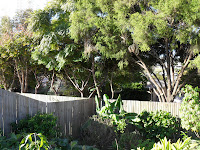
As you can see by the pics, they didn't cut as high as we would have liked, but at least there is a glimmer of hope that the sun will shine through. Maybe later on, they may come back and we may have a clearance of the back fence!!!!!
The temperature today was 7 to 26!!! And while I was watching the news at 1800, it was still 21, so no cardigan tonight. Beautiful and mild and almost balmy. You can almost hear the vegetables in the garden growing. Although I only have a few in this time of year, I think that they are thankful for the weather. The onions and garlic especially are thriving.
SIR LOP A LOT
We have had a lot of trouble with the trees over the back fence. I bought an extension lopper to bring down the limbs really hanging over on our side. The property I think is rented so they don't do much about them ---- until today. More shortly.
The trees hanging over the back fence have cut out the early morning sun, so our plants have suffered. The lopper I used to cut off some of the offending branches helped, but I just couldn't get high enough to really do any good.
I had a problem the other week when Kay was still in Melbourne. I got a bit over zealous and tried to cut a branch that was too high and too big. Consequently, the lopper got stuck in the branch and I had the devil's own time trying to get it unstuck. After about an hour of pulling and pushing, and trying to saw the branch off, I lost my temper (unusual for me????) and got the ladder and before I even reached up to get hold of the lopper, it came away and fell to the ground. Was I pissed off??? You betcha!!!! But at least I had the tool again and I eventually cut that offending branch off at a thinner spot. Job done!!!
Today the joy of all joys. Sir Lop A Lot (actual working name of the crew) and his crew turned up at the back neighbour's place and began with chain saws to cut the trees. We asked them if they were to cut them down, but disappointingly, they were only trimming them. But they did a fair job and at least we can now get a little morning sun onto our plants by the fence.


As you can see by the pics, they didn't cut as high as we would have liked, but at least there is a glimmer of hope that the sun will shine through. Maybe later on, they may come back and we may have a clearance of the back fence!!!!!
Friday, May 27, 2011
An Arts and Crafts Family - Part the Second
As promised - a continuation..............
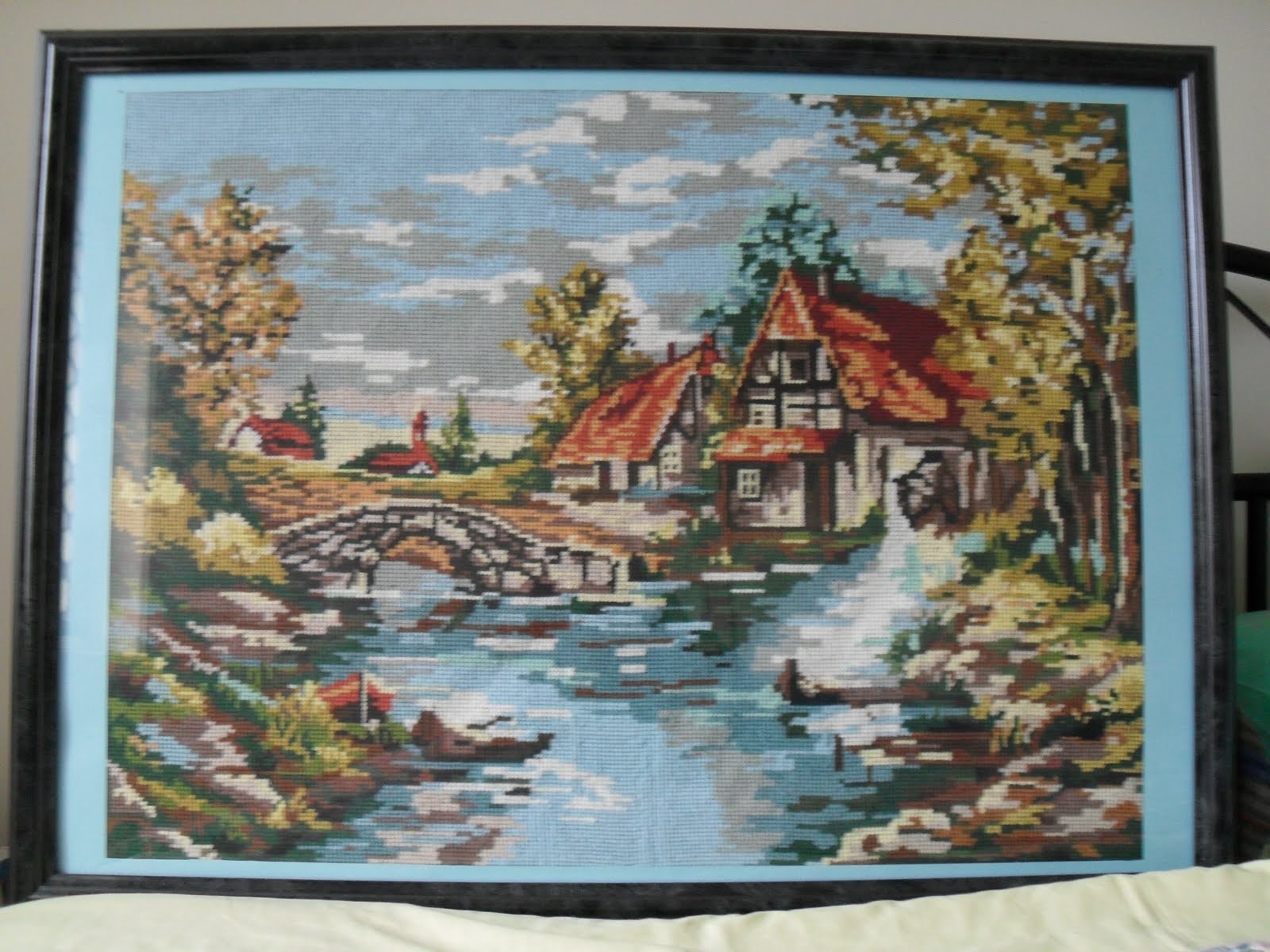
I learnt the basics of tapestry, or half cross stitch, while I was laid up in a Navy hospital. The Red Cross ladies who visited daily helped me to understand the quality and beauty of needlework. Over the years I completed several quite large tapestries and when I married Kay and she came to live in Tassie, she wanted to learn how to do tapestries, so I taught her the basics and she developed into a very talented needle worker and has completed several of her own.
I gave this tapestry to my Mum for a birthday, I seem to remember, and when she passed away, it was returned to me by my family. It is now hanging in pride of place in our house.
Kay learnt of the magic of patchwork quilting and regularly attended classes in Launceston. She made several very attractive quilts and even some shoulder bags, which she still uses.
Now that we are in Queensland, Kay has found that by attending classes here, her skills have developed beyond all expectations and now she is concentrating on wall hangings. They are spectacular, to say the least.
What is next on the learning agenda for Kay I cannot say, but I think maybe maybe embroidery could be just around the corner.
Because I sold my band saw, scroll saw, drill press and router when we left Tassie, I just don't have the tools or the space now to continue making clocks and plaques, so I have settled to making frames for Kay's wonderful wall hangings. It takes a little time to make them but they are made with the love of timber and the joy I feel when they come together. I only use a tenon saw and chisel to make the half housed lap joints and the only power tools I use is a drill to join it all up.
A real labour of love, in more ways than one.
I learnt the basics of tapestry, or half cross stitch, while I was laid up in a Navy hospital. The Red Cross ladies who visited daily helped me to understand the quality and beauty of needlework. Over the years I completed several quite large tapestries and when I married Kay and she came to live in Tassie, she wanted to learn how to do tapestries, so I taught her the basics and she developed into a very talented needle worker and has completed several of her own.
 | |
| Tapestry I did for Mum |
 | |
| One of Kay's tapestry masterpieces |
 |
| Another of Kay's tapestries |
Now that we are in Queensland, Kay has found that by attending classes here, her skills have developed beyond all expectations and now she is concentrating on wall hangings. They are spectacular, to say the least.
 | |
| Egret Wall Hanging - Kay |
 |
| Japanese wall hanging - Kay |
What is next on the learning agenda for Kay I cannot say, but I think maybe maybe embroidery could be just around the corner.
Because I sold my band saw, scroll saw, drill press and router when we left Tassie, I just don't have the tools or the space now to continue making clocks and plaques, so I have settled to making frames for Kay's wonderful wall hangings. It takes a little time to make them but they are made with the love of timber and the joy I feel when they come together. I only use a tenon saw and chisel to make the half housed lap joints and the only power tools I use is a drill to join it all up.
A real labour of love, in more ways than one.
Sunday, May 22, 2011
An Arts and Crafts Family - Part the First
Between my wife Kay and I, we have dabbled in several of the craft art forms. Kay is extremely talented in this field, where I now just stick to wood work most of the time. This usually entails making frames for Kay's wonderful works of art.
I learnt the basics of rope tying (or as they call it, bends and hitches, in the Navy, or macrame in yuppie circles) while I was in HMAS Cerberus, The Royal Australian Navy Recruit School depot at Crib Point in Victoria. This basic knowledge afforded me the opportunity to develop my own style of decorative rope work. But I think it shouldn't be called rope work as it is Navy-related. There is only one rope on board a ship and that is the bell rope. All other 'ropes' are referred to as 'lines', 'hawsers' etc.
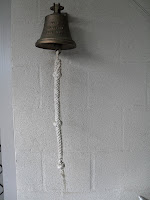
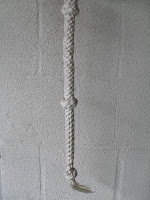 My first ship was HMAS Melbourne, an aircraft carrier, and when she was decommissioned in 1982, she was stripped of all brass work and that was melted down to make miniature ship's bells which were offered for sale. I was fortunate enough to obtain one and went about making a bell rope for this prized collector's item. Of course it was quite a while since I had dabbled much in bends, hitches and plaits, apart from teaching the basics while an Instructor Chief Petty Officer with the Naval Reserve Cadets (as they were then known). I bought several lanyards from Naval Stores and set about rekindling the grey cells to try to produce something that would look sort of OK. You can see the result. I made several attempts, and after a lot of frustration, settled on a mixture of plaits and Turk's Heads. It has become a bit bent and battered over the years but I don't want to pull it apart and repair it as it denotes a very important era of my life. My sea time.
Needlework was the mainstay of sailors in sailing ship days where sails were required to be repaired regularly. A term still used in the Navy is "Make and Mend", which means that you have time off from your regular duties to relax. But in sailing ship days it had a completely different meaning. You would cease your regular duties and plied your skills to making and mending the ship's equipment such as sails, lines, braces, etc. That brings another term to mind - "Splice the Main Brace". Now it means that every sailor gets an extra beer issue free to mark an auspicious occasion such as the death of Winston Churchill, the adoption of a new White Ensign for the Navy (I Spliced the Main Brace on both of these), or the death and succession of a King or Queen. Actually, it originally meant that the main brace on board a ship had to be replaced and spliced, which was a tremendously arduous task and the completion was rewarded with an extra tot of rum.
I had quite a large workshop/shed back home in Tasmania and my love of wood working and the often cheap availability of tools and machines from garage sales, sparked my interest in making something worthwhile and satisfying. So, I began making my own plaques and emblems depicting my Service life. Clocks also became an integral part of my leisure time as I didn't have that much to occupy my mind in the bleak winter days in Tassie. I made Naval Association clocks and then advanced to making stylised Tasmanian clocks, which I used to sell to international students for a quite reasonable price for them to take home as souvenirs and were much cheaper than the mass produced ones that were available and then branched out to include other ex-Service Associations of which I was a member. Some examples are below.
When we left Tasmania I had to sell most of my tools as we weren't sure whther we would have the space here in Yamanto to set up another workshop or not. As it turned out, we didn't!!! So, consequently, my clock and plaque making is currently at an extended halt!!!
This is enough for now. The more intricate stuff really needs its own page, so watch out for "An Arts and Crafts Family - Part the Second".
I learnt the basics of rope tying (or as they call it, bends and hitches, in the Navy, or macrame in yuppie circles) while I was in HMAS Cerberus, The Royal Australian Navy Recruit School depot at Crib Point in Victoria. This basic knowledge afforded me the opportunity to develop my own style of decorative rope work. But I think it shouldn't be called rope work as it is Navy-related. There is only one rope on board a ship and that is the bell rope. All other 'ropes' are referred to as 'lines', 'hawsers' etc.

 My first ship was HMAS Melbourne, an aircraft carrier, and when she was decommissioned in 1982, she was stripped of all brass work and that was melted down to make miniature ship's bells which were offered for sale. I was fortunate enough to obtain one and went about making a bell rope for this prized collector's item. Of course it was quite a while since I had dabbled much in bends, hitches and plaits, apart from teaching the basics while an Instructor Chief Petty Officer with the Naval Reserve Cadets (as they were then known). I bought several lanyards from Naval Stores and set about rekindling the grey cells to try to produce something that would look sort of OK. You can see the result. I made several attempts, and after a lot of frustration, settled on a mixture of plaits and Turk's Heads. It has become a bit bent and battered over the years but I don't want to pull it apart and repair it as it denotes a very important era of my life. My sea time.
Needlework was the mainstay of sailors in sailing ship days where sails were required to be repaired regularly. A term still used in the Navy is "Make and Mend", which means that you have time off from your regular duties to relax. But in sailing ship days it had a completely different meaning. You would cease your regular duties and plied your skills to making and mending the ship's equipment such as sails, lines, braces, etc. That brings another term to mind - "Splice the Main Brace". Now it means that every sailor gets an extra beer issue free to mark an auspicious occasion such as the death of Winston Churchill, the adoption of a new White Ensign for the Navy (I Spliced the Main Brace on both of these), or the death and succession of a King or Queen. Actually, it originally meant that the main brace on board a ship had to be replaced and spliced, which was a tremendously arduous task and the completion was rewarded with an extra tot of rum.
I had quite a large workshop/shed back home in Tasmania and my love of wood working and the often cheap availability of tools and machines from garage sales, sparked my interest in making something worthwhile and satisfying. So, I began making my own plaques and emblems depicting my Service life. Clocks also became an integral part of my leisure time as I didn't have that much to occupy my mind in the bleak winter days in Tassie. I made Naval Association clocks and then advanced to making stylised Tasmanian clocks, which I used to sell to international students for a quite reasonable price for them to take home as souvenirs and were much cheaper than the mass produced ones that were available and then branched out to include other ex-Service Associations of which I was a member. Some examples are below.
 |
| HMAS Melbourne and Naval Association plaques |
 |
| Naval Association clock |
 | ||
| Tassie Clock with Vietnam Veterans' Plaque |
This is enough for now. The more intricate stuff really needs its own page, so watch out for "An Arts and Crafts Family - Part the Second".
Wednesday, May 18, 2011
GM Gone Wrong????
I read with awe in the paper this morning, an article tucked away on a side column just titled "Melons go bust".
On further reading I had a bit of a giggle to myself and I was quite pleased by what I read. Genetic Modification in fruit and vegetables has finally gone wrong.
I have the wording of the article set out below. Please feel free to have a giggle with me, or even a huge guffaw if you so wish.
Melons go bust
BEIJING: The overuse of a chemical that helps fruit grow faster is causing a rash of exploding watermelons in eastern China. An investigative report by China Central Television found farms in Jiangsu province were losing hectares of fruit to the problem. It said farmers sprayed too much growth promoter, hoping they could get fruit to the market ahead of season.
So there you go. GM isn't always the miracle it is so often reported to be!!!!!
PS...... Continue guffawing!!!!!!!!!!!!!!!!!!!!!!!!1
On further reading I had a bit of a giggle to myself and I was quite pleased by what I read. Genetic Modification in fruit and vegetables has finally gone wrong.
I have the wording of the article set out below. Please feel free to have a giggle with me, or even a huge guffaw if you so wish.
Melons go bust
BEIJING: The overuse of a chemical that helps fruit grow faster is causing a rash of exploding watermelons in eastern China. An investigative report by China Central Television found farms in Jiangsu province were losing hectares of fruit to the problem. It said farmers sprayed too much growth promoter, hoping they could get fruit to the market ahead of season.
So there you go. GM isn't always the miracle it is so often reported to be!!!!!
PS...... Continue guffawing!!!!!!!!!!!!!!!!!!!!!!!!1
Sunday, May 8, 2011
Garden Gurus Know Everything??????
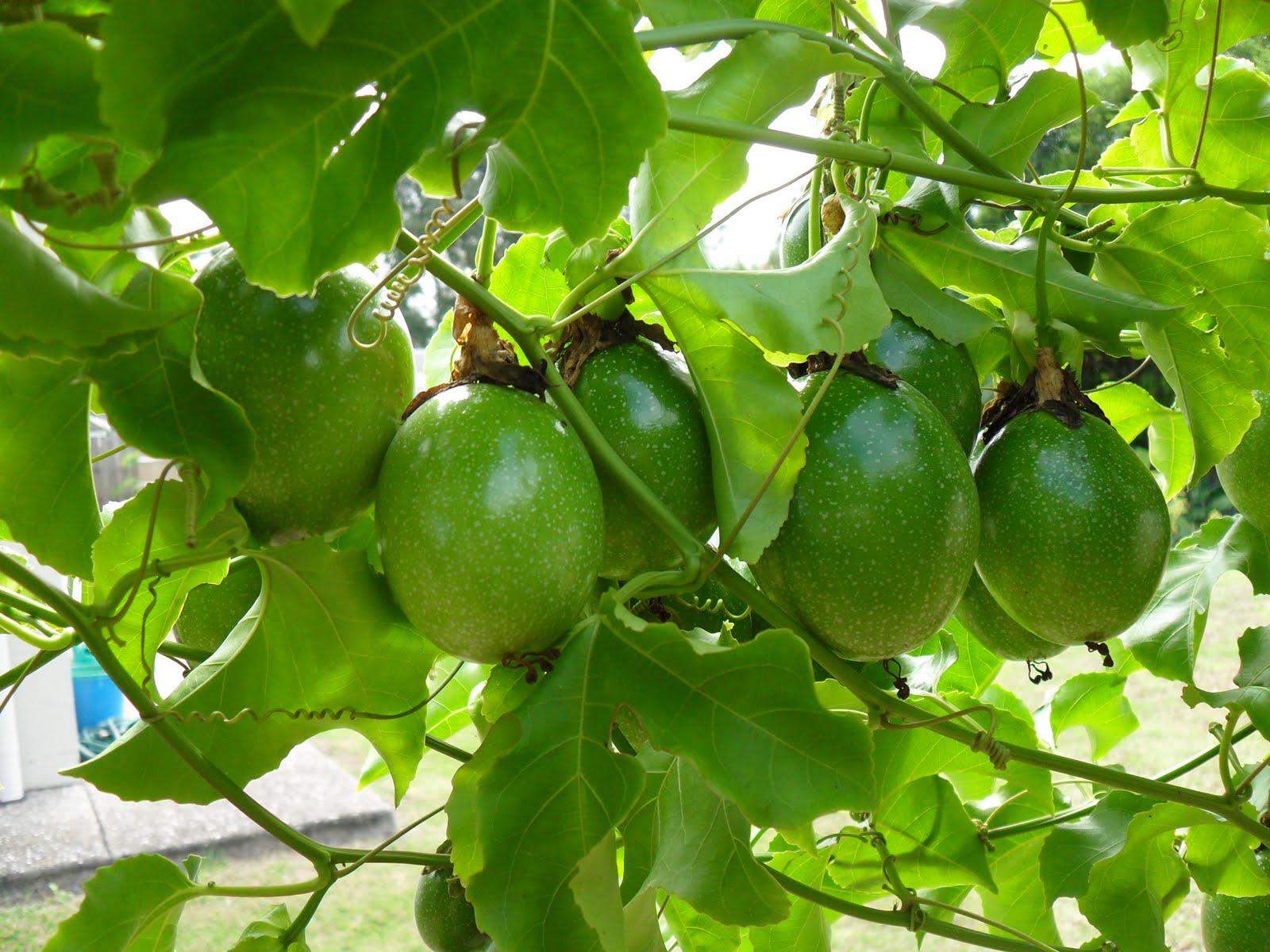
There was a gardening report in the newspaper the other day reporting that it is a very bad year in Queensland for passion fruit. I don't know where this so-called garden expert got his information, but after you take a look at the pics here, you will wonder why there is so much misinformation flying around. If this is a bad year, I can't wait for a good one!!!!
Kay brought home 2 small passion fruit plants from the market some months ago and we planted them with the hope that we would get a few this season. Well, take a look at what we have got!!! The two early ones have been picked and eaten and they were the sweetest passion fruit I have ever tasted. Can't wait for the rest to ripen and we will have a feast fit for a king.
As you can see there is going to be a bountiful harvest and these are not all of them. Every day there are more flowers and small fruit forming, so maybe we can go commercial??????
Kay brought home 2 small passion fruit plants from the market some months ago and we planted them with the hope that we would get a few this season. Well, take a look at what we have got!!! The two early ones have been picked and eaten and they were the sweetest passion fruit I have ever tasted. Can't wait for the rest to ripen and we will have a feast fit for a king.
 | ||||||
| Same lot from the back |
 | ||||
| One lot of at least 12 |
 | |
| 15 from the back |
 | ||||||||||
| Another lot of 15 |
 | |
| End lot or about another dozen |
Friday, May 6, 2011
Plant Life Magic
Plant life is on this earth for one reason and one reason only - to reproduce its species. This includes vegetables and fruit, of course.
The magic comes in many different forms and they all create a feeling of wonderment every time I consider it.
Some species of eucalyptus (gums), pinus (pines) and acacia (wattles) seasonally drop or broadcast their seeds over a wide area by "exploding" their seed cases. Out of the thousands of seeds that are ejected from a tree, only a handful will survive to sprout and regenerate the species. The seeds of eucalyptus and acacia may lay dormant in the ground for years waiting for the right conditions to suit their challenge for life. In these cases the seeds need fire for them to burst into life and the Australian bush is ideal for this as bush fires are a natural phenomenon, or sometimes, not so natural when they are caused by arsonists.
The fire awakens the seed and in a few weeks after the fire, little green shoots begin to appear from the ashes and then threats to the next stage of survival begins - destruction by human or animal intervention. After bush fires, humans will clear the burnt areas if the fire was in farmland or grazing land and they will wipe out the native flora and clear the fire debris to make way for more arable land.
This, of course, destroys the young plants struggling for survival, but Nature has allowed for this. Not all the seeds will germinate at once and over time, these resilient little seeds will germinate safely and become the majestic gum and wattle trees we all admire.
Not all seeds are tiny. Coconuts turn up everywhere near the tropics. While I was at sea around South East Asia I saw, on numerous occasions, coconut palms of every size from just sprouted nuts to fully grown ones floating in the ocean. While I was on lookout off Vietnam I actually reported a submarine periscope which turned out to be a coconut palm floating merrily along looking for somewhere to take root. This is far from rare at sea in the tropics and one sighting of what was first thought to be more palms did turn out to be submarines!! As far as I know, the nationality of those subs who stalked us all the time we were in Vietnam waters has never been established, except that they WERE NOT FRIENDLIES!!!!!
In my garden, it never ceases to amaze me that such large and delicious vegetables and fruit can be grown from such small seeds. One little seed will produce a plant which, if tended properly, will produce several kilos of rich, red and juicy tomatoes. And any other vegetable, or fruit for that matter, that grows above ground, will produce more and more the more you pick them. The vegetable grows its babies to produce seed, not to feed us (that is just a lucky by-product for us), so if you pick the mature ones, the plant realises that it has lost that crop of potential seeds and will produce more until, at the last, the plant is too old and tired, and dies.
ISN'T MOTHER NATURE WONDERFUL?????
The magic comes in many different forms and they all create a feeling of wonderment every time I consider it.
Some species of eucalyptus (gums), pinus (pines) and acacia (wattles) seasonally drop or broadcast their seeds over a wide area by "exploding" their seed cases. Out of the thousands of seeds that are ejected from a tree, only a handful will survive to sprout and regenerate the species. The seeds of eucalyptus and acacia may lay dormant in the ground for years waiting for the right conditions to suit their challenge for life. In these cases the seeds need fire for them to burst into life and the Australian bush is ideal for this as bush fires are a natural phenomenon, or sometimes, not so natural when they are caused by arsonists.
The fire awakens the seed and in a few weeks after the fire, little green shoots begin to appear from the ashes and then threats to the next stage of survival begins - destruction by human or animal intervention. After bush fires, humans will clear the burnt areas if the fire was in farmland or grazing land and they will wipe out the native flora and clear the fire debris to make way for more arable land.
This, of course, destroys the young plants struggling for survival, but Nature has allowed for this. Not all the seeds will germinate at once and over time, these resilient little seeds will germinate safely and become the majestic gum and wattle trees we all admire.
Not all seeds are tiny. Coconuts turn up everywhere near the tropics. While I was at sea around South East Asia I saw, on numerous occasions, coconut palms of every size from just sprouted nuts to fully grown ones floating in the ocean. While I was on lookout off Vietnam I actually reported a submarine periscope which turned out to be a coconut palm floating merrily along looking for somewhere to take root. This is far from rare at sea in the tropics and one sighting of what was first thought to be more palms did turn out to be submarines!! As far as I know, the nationality of those subs who stalked us all the time we were in Vietnam waters has never been established, except that they WERE NOT FRIENDLIES!!!!!
In my garden, it never ceases to amaze me that such large and delicious vegetables and fruit can be grown from such small seeds. One little seed will produce a plant which, if tended properly, will produce several kilos of rich, red and juicy tomatoes. And any other vegetable, or fruit for that matter, that grows above ground, will produce more and more the more you pick them. The vegetable grows its babies to produce seed, not to feed us (that is just a lucky by-product for us), so if you pick the mature ones, the plant realises that it has lost that crop of potential seeds and will produce more until, at the last, the plant is too old and tired, and dies.
ISN'T MOTHER NATURE WONDERFUL?????
Subscribe to:
Comments (Atom)